Human-induced pluripotent stem cell (iPSC)-derived neurons offer a uniquely relevant platform for studying synaptic function with direct human genetic context. As these cells mature in vitro, they progressively develop the electrophysiological properties needed to support reliable pharmacological assays — but the timeline and trajectory of that maturation differ meaningfully between cell types. Understanding when and how synaptic activity emerges is essential for designing experiments that generate interpretable, reproducible data.
At Neuroservices-Alliance, we characterized miniature excitatory postsynaptic currents (mEPSCs) in two commercially available iPSC-derived neuron subtypes — iCell Glutamatergic (Gluta) and iCell Motor neurons — tracking their synaptic properties from 2 through 8 weeks in vitro.
THE ASSAY
mEPSCs are small, spontaneous synaptic currents that occur independently of action potentials, reflecting the probabilistic release of single synaptic vesicles onto postsynaptic AMPA receptors. Their frequency is a direct indicator of synaptic connectivity — more functional synaptic contacts generate more events. Their amplitude reflects postsynaptic receptor density and sensitivity. Together, these two endpoints provide a quantitative window into how mature and synaptically integrated a neuron is at any given point in development.
Three endpoints were tracked across the maturation time course: cell capacitance (a measure of cell size and membrane surface area), mEPSC frequency, and mEPSC amplitude.
RESULTS
Both iCell Gluta and iCell Motor neurons developed measurable mEPSC activity over the 8-week period, but with distinct profiles.
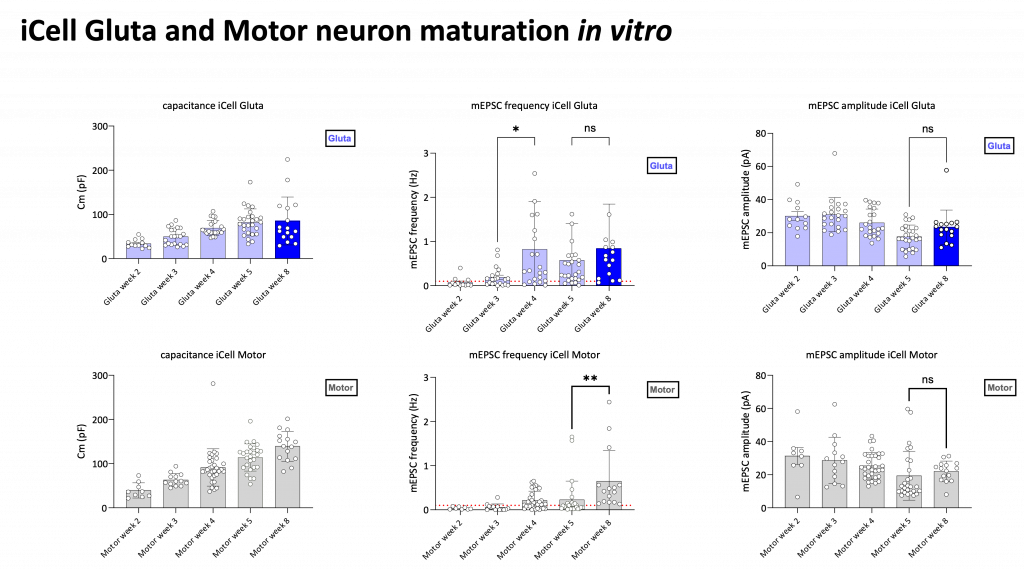
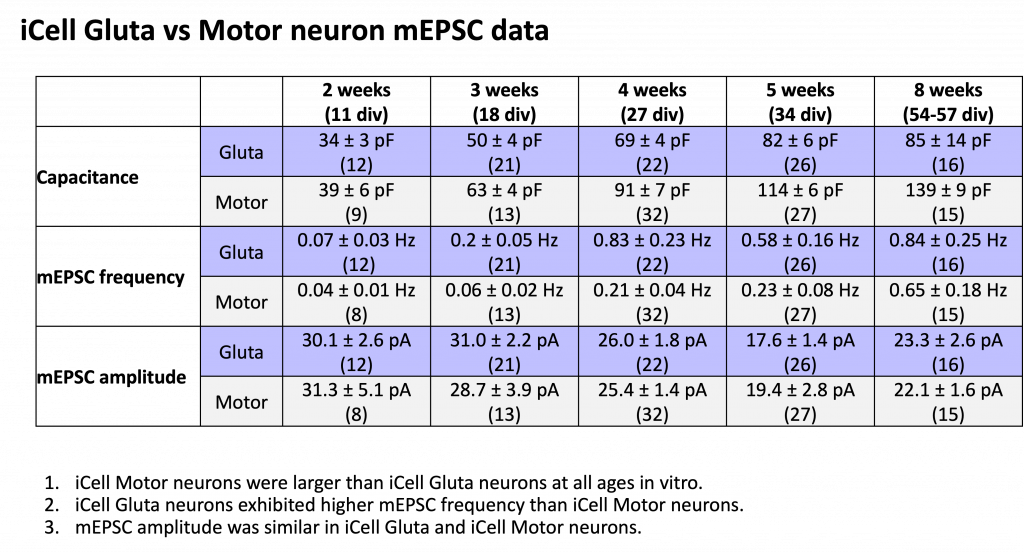
- Cell size increased progressively in both subtypes, with Motor neurons consistently larger than Gluta neurons at every timepoint — growing from ~39 pF at 2 weeks to ~139 pF at 8 weeks, compared to ~34 pF to ~85 pF for Gluta neurons.
- mEPSC frequency was the most dynamic endpoint. In iCell Gluta neurons, frequency rose sharply between weeks 3 and 4 — from 0.2 Hz to 0.83 Hz — and remained at that level through week 8, indicating that functional synaptic connectivity is largely established by week 4. iCell Motor neurons showed a slower, more gradual increase, reaching 0.65 Hz by week 8 but remaining substantially lower than Gluta neurons at equivalent timepoints throughout.
- mEPSC amplitude was strikingly stable. Both subtypes recorded amplitudes of approximately 30 pA at 2 weeks, with a modest decline to ~22–23 pA by week 8. Critically, amplitude was similar between iCell Gluta and Motor neurons at all ages — suggesting that quantal size is set early in development and is largely independent of the maturation processes that drive changes in frequency and cell size.
CONCLUSION
These results establish a clear maturation profile for two widely used iPSC neuron subtypes and provide practical guidance for assay timing. For iCell Gluta neurons, week 4 represents a reliable window for mEPSC-based assays, when synaptic frequency has reached a stable plateau. Motor neurons require longer culture periods to achieve comparable synaptic activity. The stability of mEPSC amplitude throughout maturation confirms that postsynaptic receptor function is consistent across timepoints, making frequency the more sensitive and informative endpoint for tracking synaptic development or detecting compound effects.
Human iPSC-derived neurons are an increasingly important component of our electrophysiology platform — complementing our primary rodent models with human-relevant data for pharmacology, gene therapy validation, and disease modeling programs.
Related reading
Go back