iPSC Cells for Drug Discovery: Assay Choices, Limits, and FDA Relevance
8 min read
Human induced pluripotent stem cells earned their place in CNS and pain programs for a straightforward reason: they give access to disease-relevant human cell types that animal models approximate imperfectly, and to tissues that are otherwise difficult to obtain, including brain and cardiac muscle. A 2014 review in Pharmacology & Therapeutics frames that reach explicitly, extending toxicity and teratogenicity testing to rare and multifactorial disease. A more recent review of patient-derived lines describes them as scalable enough to support phenotype-based small-molecule screening in CNS indications. Regulators have taken note as well: the FDA’s 2020 report on new alternative methods names patient-specific iPSC-derived cardiomyocytes among development tools that can reduce, refine, or replace animal testing.
So the useful question is no longer whether iPSC cells for drug discovery are worth using. It is which biological question a given differentiated culture can answer with enough confidence to support a go/no-go decision.
That confidence depends on constraints scientists have to manage deliberately. Nature Reviews Drug Discovery flagged embryonic-like maturity, genetic and epigenetic instability, and the difficulty of modeling complex sporadic disease early on, and batch-to-batch variability and phenotype fidelity remain live issues.
What follows is about execution: matching readouts to questions, managing translational risk, and building a validation strategy around these systems.
What iPSC-derived assays can answer better than traditional models
The strongest argument for iPSC systems is access. Reprogrammed patient cells give you disease-relevant neurons, cardiomyocytes, and other lineages from tissues that cannot be biopsied at scale — a point made in a 2014 review of iPSC applications in drug testing, which highlights brain and cardiac muscle alongside rare and multifactorial conditions where no animal model reproduces the patient genotype. A 2021 CNS-focused review in PMC describes patient-derived lines as scalable enough to support phenotype-based small-molecule screening, which matters most when the target is unconfirmed: you can score a cellular phenotype — network firing, calcium handling, neurite integrity — without committing to a mechanism first.
Human cells also change the evidence you can offer regulators. The FDA’s 2020 report on alternative methods names patient-specific iPSC-derived cardiomyocytes as a development tool, so human-relevant toxicity and teratogenicity data now sits inside an accepted regulatory conversation rather than outside it.
Where these systems earn less is depth. Broad screening utility and mechanistic resolution are different jobs. Answering how a compound modifies a specific conductance, or whether it alters synaptic plasticity in an intact circuit, still calls for manual patch clamp and brain slice recordings. The practical use of iPSC cells for drug discovery is triage at scale, with mechanistic assays confirming what the phenotype flagged.
How to choose the right readout: patch clamp, calcium imaging, MEA, or phenotype
The advantage of iPSC cells for drug discovery is human genetic context — but that relevance only converts into a decision when the readout matches the question being asked.
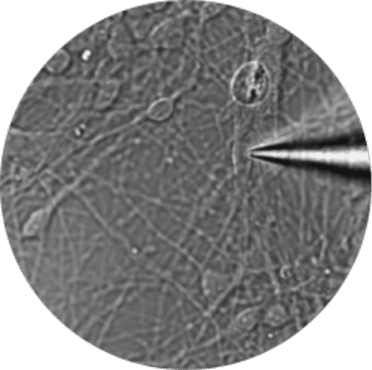
Manual patch clamp is the right tool for mechanism. If you need resting membrane potential, action potential waveform and firing properties, or the biophysics of voltage-gated sodium and potassium currents, single-cell recording is the only readout that resolves state-dependence, use-dependence, and true potency at the channel. It is low throughput by construction, so it belongs at target validation, hit characterization, and mechanism-of-action confirmation rather than primary screening.
Calcium imaging scales. It reports stimulus-evoked and sensitized responses across large populations of iPSC-derived sensory neurons and nociceptors, which makes it well suited to concentration-response work and screening campaigns. The tradeoff is granularity: calcium flux is an indirect, kinetically slow proxy for membrane events, so it can rank compounds but rarely explains them.
Multielectrode arrays capture what neither single-cell nor imaging readouts see — spontaneous firing, burst structure, and synchrony across a network. For excitability, and seizure liability questions in neuronal cultures, population activity is the endpoint that matters.
Morphology and phenotype — neurite outgrowth, branching, marker expression — flag effects on differentiation, maturation, or neuronal health, but they do not predict analgesic efficacy on their own.
No single layer is sufficient. Choose the readout that answers the decision in front of you, then confirm mechanism with a second, orthogonal one.
FDA expectations and the role of patient-specific iPSC models
Regulatory language has moved in favor of human-relevant systems. The FDA’s 2020 report to Congress on advancing alternative methods describes agency support for developing and qualifying new regulatory approaches and alternatives intended to reduce, refine, or replace animal testing — and it names patient-specific iPSC-derived cardiomyocytes among the development tools in play. That inclusion matters: it signals that a human-derived, functionally measurable cell system can be treated as an evidence generator rather than a discovery-stage curiosity.
The wording is about method development and qualification, though, not blanket acceptance. A regulator’s interest in the technology does not validate your particular assay. What carries weight is a defined context of use, documented reproducibility across differentiation batches and donor lines, pharmacological benchmarking against reference compounds with known clinical behavior, and readouts matched to the mechanism being tested. The maturity caveats raised in the 2011 Nature Reviews Drug Discovery analysis of iPSCs — embryonic-like phenotype, genetic and epigenetic drift — are assay design problems to be characterized, not disclaimers to be footnoted.
This is where orthogonal evidence changes the strength of a package. Ion channel pharmacology resolved by manual patch clamp in iPSC-derived sensory neurons, corroborated by calcium imaging or MEA network endpoints and then confirmed in native tissue such as brain slice or dorsal root ganglion recordings, gives reviewers convergent data. Used that way, iPSC cells for drug discovery support a translational argument instead of resting on human origin alone.
Where iPSC models still fall short in translational screening
Human relevance is the reason iPSC cells for drug discovery moved from novelty to routine, and it is also the reason expectations drift ahead of the biology. The 2011 Nature Reviews Drug Discovery analysis of stem-cell-based screening flagged three constraints that have not disappeared: embryonic-like maturity, genetic and epigenetic drift, and uncertain fidelity when modeling complex sporadic disease.
Maturity is the one that most often distorts interpretation. Immature neurons carry different channel expression, resting membrane potential, and firing properties than adult cells, so a compound’s apparent potency can reflect developmental stage rather than target pharmacology. Many neuronal protocols need extended differentiation — often beyond 30 days — before recordings represent the phenotype you intended to interrogate.
Batch-to-batch variability is the second. Without fixed differentiation protocols, defined culture conditions, and pre-agreed quality control acceptance criteria, drift between lots is indistinguishable from a treatment effect.
The third is overclaiming. A patient-derived line reproduces a genotype; it does not reproduce age, comorbidity, immune context, or circuit-level pathology. Reviews of patient-derived systems in CNS screening describe them as scalable phenotypic platforms — not as replacements for network-level or in vivo evidence.
The practical consequence: screening signals from iPSC-derived sensory neurons or cortical cultures gain translational weight when they are confirmed in a complementary system, such as brain slice recordings, before a program commits. Better human relevance still demands model qualification.
What to look for in an iPSC screening partner
Start with the reasoning, not the equipment list. A partner should be able to explain why a given readout answers your mechanism — voltage-gated sodium channel pharmacology, sensitization of nociceptors, network-level firing — rather than reciting available platforms. That logic is where the human-relevance advantage of iPSC systems is either realized or lost: donor-derived neurons only reduce species mismatch if the assay actually interrogates the biology you care about. The regulatory direction supports this. In its 2020 report to Congress on alternative methods, the FDA described support for approaches that reduce, refine, or replace animal testing and cited patient-specific iPSC-derived cardiomyocytes among the development tools in use.
Practical questions to put to any CRO:
- Which readout for which question — manual patch clamp for channel-level mechanism, calcium imaging for stimulus-evoked responses, multielectrode arrays for scaled functional screening.
- How maturation is handled, given that many neuronal differentiation protocols need more than 30 days before phenotypes stabilize.
- How reproducibility and validation are demonstrated across differentiation batches and cell lines.
- Whether iPSC data can be confirmed orthogonally, including ex vivo systems, when a single model won’t carry the decision.
Metrion Biosciences has published validation work on human iPSC-derived sensory neuron phenotyping and on ventricular iPSC-cardiomyocytes for proarrhythmia risk. Neuroservices-Alliance builds customizable assays around manual patch clamp and brain slice work. The right fit still depends on your scientific question.
A practical framework for defensible iPSC assay strategy
Work in one direction, and the plan stays defensible. Start from the biological question — is it target engagement, excitability, network activity, or a phenotype? Then choose the cell type that carries the relevant biology, whether cortical neurons, sensory neurons and nociceptors, or cardiomyocytes. Only then pick the readout: manual patch clamp for mechanism and biophysics, calcium imaging for throughput on ion channel and receptor pharmacology, multielectrode array recordings for network-level effects. Where a decision carries pipeline risk, confirm it with an orthogonal method or complementary ex vivo brain slice work rather than a single endpoint.
Judge phenotype, function, and translational relevance together. A culture with the right marker profile but immature firing properties is not yet a predictive system — maturation time, batch-to-batch variability, and epigenetic stability all belong in the qualification record, as the 2011 assessment in Nature Reviews Drug Discovery flagged early. Regulators have moved in step: the FDA’s 2020 report on reducing animal testing names patient-specific iPSC-derived cardiomyocytes as a development tool, which raises rather than lowers the documentation bar.
Use human iPSC models for human-relevant insight; qualify them before calling them predictive.
If your program needs electrophysiology-led iPSC screening, contact Neuroservices-Alliance.