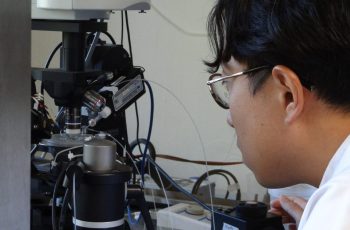
This collaboration paired BrainXell’s sensory neuron model with Neuroservices-Alliance’s whole-cell patch-clamp expertise to answer a foundational question: after maturation in vitro, do these neurons actually behave like real sensory neurons, generating action potentials and carrying the voltage-gated sodium currents that define excitable, physiologically relevant cells?
Using whole-cell patch-clamp recording, the study evaluated neuronal membrane properties, intrinsic excitability, action potential firing, and voltage-gated sodium currents following 5–6 weeks of in vitro maturation.
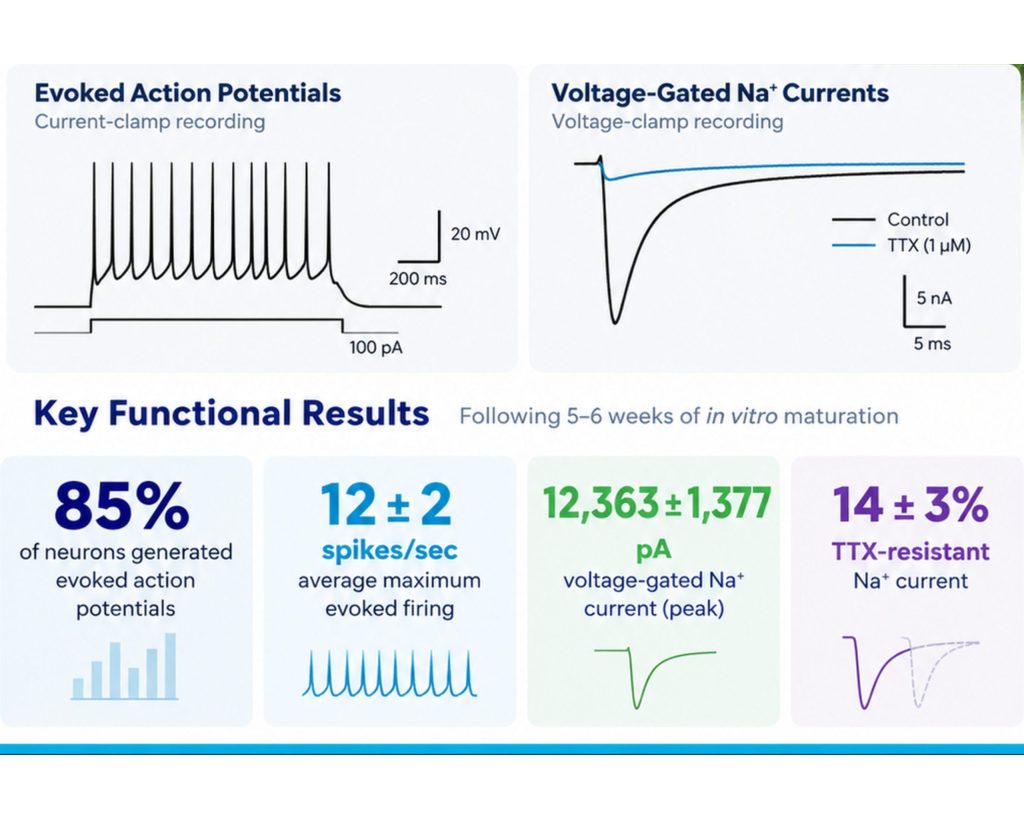
BrainXell Sensory Neurons displayed key electrophysiological characteristics of functional neurons, including negative resting membrane potentials. Importantly, 85% of neurons tested generated evoked action potentials, with responsive cells producing an average maximum of 12 ± 2 spikes during a one-second current injection.
Voltage-clamp analysis further demonstrated large voltage-gated Na⁺ currents, reaching 12,363 ± 1,377 pA under the CsCl/CsF recording condition. Most of the measured sodium current was TTX-sensitive, while approximately 14% was TTX-resistant, adding further functional characterization of the ion-channel activity present in the model.
These findings provide additional characterization of BrainXell Sensory Neurons and demonstrate their ability to develop functional neuronal properties and stimulus-evoked activity following maturation. The collaboration also highlights the complementary capabilities of BrainXell and Neuroservices-Alliance: combining human iPSC-derived sensory neuron models with specialized electrophysiological characterization to support pain biology, ion-channel research, and preclinical drug discovery. Neuroservices-Alliance specifically supports electrophysiological characterization of human iPSC-derived neurons and pain-relevant targets including TRPV1 and NaV1.7/1.8/1.9.