Modeling the Long Shadow of Opioid Craving: What Cue-Induced Reinstatement Tells Us About Relapse
News
28.09.2026
#ADDICTION STUDIES, #BEHAVIORAL STUDIES, #IN VIVO BRAIN, #IN VIVO STUDIES, #OPIOID ADDICTION, #OPIOID WITHDRAWAL, #OPTOPATH
One of the most stubborn challenges in addiction research is relapse , the fact that craving for a drug doesn’t fade with abstinence, it can actually get stronger over time. This phenomenon, known as “incubation of craving,” is a major reason addiction treatments that work in early withdrawal often fail weeks or months later.
In a recent in vivo study conducted on our OPTOPATH platform (Bordeaux, France), our team investigated this exact question using an oxycodone self-administration model in rats, one of the gold-standard paradigms for studying opioid dependence and relapse-like behavior.
WHAT WE DID
Rats were trained to self-administer oxycodone by by poking their nose into a designated hole, with the drug delivery paired with a sensory “cue” (a light and tone) — much like the sight of a bar or a lighter can become powerfully associated with drug use in humans. After training, the animals went through a withdrawal period, then were tested to see how strongly they would still respond to the drug-associated cue alone (with no drug actually available) — a model for real-world relapse triggers.
Three groups were compared to isolate the specific role of the cue: rats trained WITH cues and tested WITH cues (the full “craving” model), rats trained WITH cues but tested WITHOUT cues (extinction control), and rats trained WITHOUT cues but tested WITH cues (cue-specificity control). Testing happened at three time points during withdrawal — 1 day, 15 days, and 30 days — to track how the craving response evolves over time.
WHAT WE FOUND:
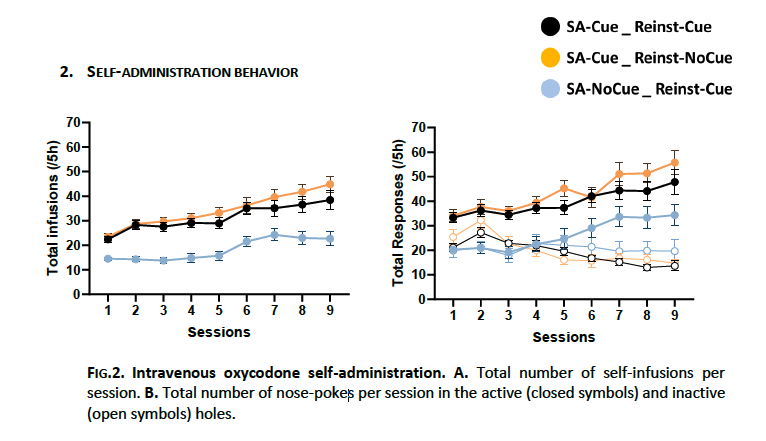
The cue clearly matters: rats trained with the drug-paired cue self-administered more oxycodone than those without it, confirming that environmental cues actively shape drug-taking behavior, not just the drug’s pharmacological effect itself.
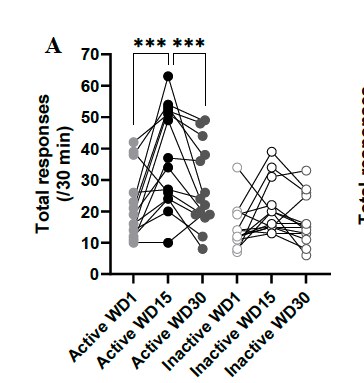
Craving intensified with time away from the drug: the group trained and tested with the cue showed a stronger drive toward the (now empty) drug-paired hole at 15 days of withdrawal than at just 1 day, a clear signature of “incubation,” the same phenomenon thought to underlie clinical relapse risk long after detox.
The effect faded by day 30: interestingly, the peak of this incubated craving was at day 15, with some decline by day 30, a nuance that matters for understanding the time-course of relapse vulnerability, and for choosing when to test candidate therapeutics.
Incubation of cue-induced reinstatement in the three experimental groups. Evolution of active responses (and inactive respnses) during WD1, WD15 and WD30 sessions in each of the three experimental groups. A. Group exposed to cues during both SA and during reinstatement (SA-Cue_Reinst-Cue).
WHY IT MATTERS:
This kind of behavioral pharmacology model gives drug developers a rigorous, quantifiable way to test whether a candidate compound can blunt cue-triggered craving and relapse-like behavior — a critical checkpoint on the path to a therapy that helps people stay in recovery, not just get through withdrawal.
Incubation of craving is one of the clearest reminders that relapse risk isn’t static — it changes shape over the course of withdrawal, and a therapeutic that works on day 1 may not work on day 15, or vice versa. By isolating the cue’s specific contribution and tracking the response across three withdrawal timepoints, this model gives a quantifiable, time-resolved readout of exactly when cue-triggered craving peaks and how it evolves — insight that’s directly actionable for deciding when and how to test a candidate compound’s anti-relapse potential. It’s this kind of rigorous, behaviorally validated in vivo model that makes the OPTOPATH platform a valuable tool for addiction and CNS drug development programs — if your team is working on a compound aimed at relapse prevention or craving, reach out to talk through how this model could fit your program.